Early German-American Imprints

Prof. Heinz Wilsdorf

About a man who fulfilled his dream in the hearvest of his life,

about the book he wrote and the collection of valuable imprints he left to his old university in Goettingen
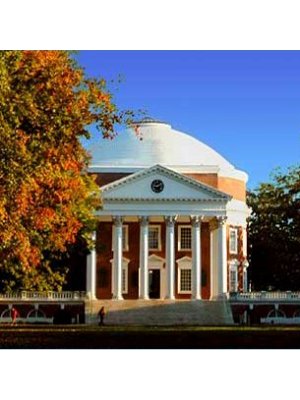
University of Virginia

Charlottesville a lifely town in beautiful Virginia:

Named in honor of Princess Charlotte, the wife of George III, Charlottesville was settled in the eighteenth century on a hill overlooking the Rivanna River. Today it is a small, thriving city with a population of 40,000 that has kept up with the well-cultivated tastes of its inhabitants. In the quiet times of the day, you can just glimpse the sleepy southern town that was Charlottesville forty years ago. But as the sun rises Downtown moves firmly into the twenty-first century. It is the legal, financial, and social hub of the community. Recently, the Downtown mall has undergone a renaissance which has brought more people to the area for recreation. The countryside, especially in the springtime, ranks among the most beautiful sites in the nation and has numerous Civil War sites and historical markers detailing more than two hundred years of history. One of the most popular sites to visit in the area is Monticello, Thomas Jefferson's home.

Thomas Jefferson founded the University in 1819

The University of Virginia in Charlottesville, VA was founded in 1819 by Thomas Jefferson (1743–1826). Jefferson, author of the American Declaration of Independence and third president of the United States, was also a talented architect of neoclassical buildings. He designed Monticello (1769–1809), his plantation home, and his ideal 'academical village' (1817–26), which is still the heart of the University. Today the University of Virginia is distinctive among institutions of higher education and sustains the ideal of developing, through education, leaders who are well-prepared to help shape the future of the nation. In the 10 years since U.S. News began ranking public universities as a separate category, U.Va. has ranked either No. 1 or No. 2. and remains the No. 2 best public university in the 2007 edition of the U.S. News and World Report rankings. The University offers forty-eight bachelor's degrees in forty-six fields, ninety-four master's degrees in sixty-four fields, six educational specialist degrees, two first-professional degrees (law and medicine), and fifty-five doctoral degrees in fifty-four fields.

The school of engineering and applied science

The Engineering School of the University of Virginia where Heinz Wilsdorf held the position of Chairman of the Department of Materials Science for its first thirteen years and continued his active important role until his retirement in 1990, latest as the Director of the Light Metals Center, has the Mission Statement "To achieve international prominence as a student-focused school of engineering and applied science that educates men and women to be leaders in technology and society and that contributes to the well-being of our citizens through the creation and transfer of knowledge." Today it has 1,993 undergraduate and 654 graduate students. The average SAT score for first year students is 1353 out of a possible 1600 and 76% of SEAS students were in the highest decile rank of their high school class. The Engineering School received approximately $50 million in new research awards in the year ending June 30, 2005. (see Facts at a Glance)

Wilsdorf Hall dedicated in 2006

The School of Engineering and Applied Science dedicated Wilsdorf Hall, a $43.4 million state-of-the-art facility designed to foster collaborative research in materials science and engineering, chemical engineering and nanotechnology, in a ceremony on Nov. 10 2006 attended by more than 250 people. The lead gift of $15 million for this building came from alumnus Greg Olsen, a 1971 graduate of the Department of Materials Science. Greg's gift was the largest ever received by the school and he chose to give it in honor of the Wilsdorfs, who were his professors during his student years there. Wilsdorf Hall is a 99,000 gross-square-foot, five-story structure that links the University's materials science and chemical engineering buildings. It includes research laboratories, faculty offices, conference rooms, computational facilities, and work-study areas. University President John T. Casteen remarked at the dedication that many buildings at universities around the world are named for faculty members, but that it was unusual for a building with major private funding to be named in honor of faculty members by a former student. “The mentoring relationship that Doris Kuhlmann-Wilsdorf had with Greg Olsen is a shining example of the vital and treasured relationships that exist between our faculty members and our students.” (see Building Wilsdorf Hall)